
Thursday, December 10, 2009
Final Exam
Just a reminder: the final exam is Monday, December 14th, at 4:45 p.m. in our normal classroom. It should take about an hour to complete it, but you'll have two hours to take it just in case.

Monday, December 7, 2009
Paper Guideline
UPDATE: New due date!
Due Date: at the beginning of class onWednesday, December 9th, Monday, December 14th, 2009
Worth: 15% of your overall grade
Length/Format: Papers must be typed, and must be no more than 1200 words long. Also, you must cite at least two sources. I do not care how you cite them; just cite them in a way that I can find your sources if I have to.
Assignment: Write an essay in which you explain and defend your answer to the following question:
In addition to your research, though, I want you to demonstrate your critical thinking abilities. Don't simply accept someone's theory because it's published in a fancy newspaper or magazine. Evaluate the reasons they offer in support of their proposed explanation. Choose the explanation that you think is most likely to be true given the evidence at your disposal, and defend your choice.
Here are some links to get you started.
Due Date: at the beginning of class on
Worth: 15% of your overall grade
Length/Format: Papers must be typed, and must be no more than 1200 words long. Also, you must cite at least two sources. I do not care how you cite them; just cite them in a way that I can find your sources if I have to.
Assignment: Write an essay in which you explain and defend your answer to the following question:
What, if anything, does last year's financial crisis show about the ethics of the capitalism?This paper requires some research. That is, in answering your question, you should try your best to figure out what actually happened to cause last year's financial crisis. This will be difficult, since there are several competing hypotheses that various experts and non-experts endorse. You should do your best to become familiar with these various proposed explanations. (As stated above, for this paper you must provide citations of at least two sources... and I recommend researching and using a lot more than that!)
- First, briefly explain your understanding of what happened that led to last year's subprime mortgage collapse and ensuing financial crisis. In your opinion, what caused all this? Consider multiple possible hypotheses, and explain and defend why your explanation is a better hypothesis than the other ones.
- Next, explain what you think this explanation of the crisis tells us about the ethics of the economic system of capitalism. Should we blame the free market for last year's collapse? Or should we blame too much government regulation? Or is something else to blame? Be sure to fully defend your opinions.
In addition to your research, though, I want you to demonstrate your critical thinking abilities. Don't simply accept someone's theory because it's published in a fancy newspaper or magazine. Evaluate the reasons they offer in support of their proposed explanation. Choose the explanation that you think is most likely to be true given the evidence at your disposal, and defend your choice.
Here are some links to get you started.
What happened? Explainers:What caused the crisis? Hypotheses and rebuttals:
- A brief explanation and how it spread (Economics Help blog)
- The subprime mortgage crisis (This American Life)
- Law professor Michael Greenberger's explanation of the mortgage crisis (Fresh Air)
- The larger financial fallout from the mortgage crisis (This American Life)
- Greenberger's explanation of the fallout (Fresh Air)
- Why Lehman Brother's failure hurt so much (Slate)
- The financial crisis: a play in 6.5 acts
DEREGULATION THEORIES
- Too much trust in free markets! (economist Paul Krugman) ...economist David Levine's response to Krugman
- I used to trust free markets, but now I don't (judge Richard Posner) ...an interview with Posner
- Blame free market capitalism! (Slate)
- Blame Reagan's deregulation! (journalist Jeff Madrick)
- We need more regulation! (economist Robert Pollin)
FREE MARKET THEORIES- It wasn't deregulation, it was bad regulation (historian Niall Ferguson)
- Too much trust in economist's formal models! (economist David Colander)
- Poor corporate governance & too much reliance on ratings agencies! (historian Charles Calomiris)
- It wasn't irrationality, or bonuses, or capitalism... it was regulation! (political scientist Jeffrey Friedman)
- So many myths, but the real story is regulation! (economist Arnold Kling)
OTHER THEORIES- Debate: Wall Street vs. Government (various)
- Overconfidence! (journalist Malcolm Gladwell) ...more thoughts on the 'Overconfidence!' hypothesis
- Capitalism's inherent instability! (economist Hyman Minsky) ...the free market response to Minsky
Sunday, December 6, 2009
Course Evaluations
As you may have heard, course evaluations are now being done online. Here are instructions to do this for your Fall 2009 classes:
1. Go to http://cp.rowan.edu/cp/.
2. Click "Student Self-Service" icon.
3. Click "Access Banner Services - Secure Area - login Required."
4. Enter User ID and PIN.
5. Click "Personal Information."
6. Click "Answer a Survey."
7. Click on one of the student evaluations for your classes.
8. Complete the student evaluation.
9. Click “Survey Complete” to submit your completed student evaluation.
10. Repeat for other Fall 2009 classes.
Tuesday, December 1, 2009
CEO Pay
So the article we're reading for class argues that the root cause of the increase in CEO pay is the ratcheting from unrepresentative "peer-group comparisons" of similarly qualified CEO's at other companies. For some reason, overpaid peers stand out more.
This highlights the similarity between the inflated pay of CEO's and star athletes. There's been a rapid rise due to a small minority of shareholders/owners overpaying for a few CEO's/athletes, which has inflated the competitive value for similarly skilled CEO's/players. This ratcheting system doesn't seem financially justifiable for two reasons: (1) top CEO's/players today probably aren't 10 times more valuable than top CEO's/players from 50 years ago; and (2) top CEO's/players probably aren't 100 times more important to their organization than the average employee/player they work with.
Economist Robin Hanson points out a recent paper that extends this analogy between CEO's and athletes. He also compares CEO's to actors and musicians by focusing on the high cost of trying out new CEO's, along with the prevalence of short-term deals. The few short-term winners renegotiate at much higher terms, and are free to continually renegotiate their salaries into the stratosphere. Hanson suggests agreeing to more long-term deals at the beginning to help solve this problem.

This highlights the similarity between the inflated pay of CEO's and star athletes. There's been a rapid rise due to a small minority of shareholders/owners overpaying for a few CEO's/athletes, which has inflated the competitive value for similarly skilled CEO's/players. This ratcheting system doesn't seem financially justifiable for two reasons: (1) top CEO's/players today probably aren't 10 times more valuable than top CEO's/players from 50 years ago; and (2) top CEO's/players probably aren't 100 times more important to their organization than the average employee/player they work with.
Economist Robin Hanson points out a recent paper that extends this analogy between CEO's and athletes. He also compares CEO's to actors and musicians by focusing on the high cost of trying out new CEO's, along with the prevalence of short-term deals. The few short-term winners renegotiate at much higher terms, and are free to continually renegotiate their salaries into the stratosphere. Hanson suggests agreeing to more long-term deals at the beginning to help solve this problem.
Saturday, November 28, 2009
What Commercials Taught Me
Here's a great TED talk by Rory Sutherland on the lessons he's learned as an advertiser:
I'd like to teach an entire class on TED talks. Some of my other favorites:
I'd like to teach an entire class on TED talks. Some of my other favorites:
Thursday, November 26, 2009
After a Word from Our Sponsors
Here are some links on advertising and reasoning.

- The first is about the underlying intellectual dishonesty in even the most honest of ad campaigns.
- By the way, if you're into advertising, that entire blog is great. I'm a bit biased, though, since I used to work with the guy who writes it.
- Here's a radio interview with the director of FactCheck.org, a great website devoted to debunking claims in political ads.
- I also used to work with the guy who interviewed FactCheck's director. Yup, I'm a pretty big deal.
- I wish those fact checking websites made a difference. Actually, I just wish they didn't hurt their own cause. Silly humans and your naturally biased minds!
Tuesday, November 24, 2009
BS
Want to learn more about bullshit? A philosopher has written a book on it! You can buy Harry Frankfurt's book On Bullshit here... or read it online for free here. Or, be lazy and watch Frankfurt's appearance on The Daily Show.
Some more interviews with Frankfurt about the book are here and here. What do you think? Is not caring about whether you're telling the truth worse than deliberately lying?
Some more interviews with Frankfurt about the book are here and here. What do you think? Is not caring about whether you're telling the truth worse than deliberately lying?
Friday, November 20, 2009
"Barb" on My Nametag
Barbara Ehrenreich is famous enough to be on the tv a lot. Here's her appearance on The Colbert Report (she even drops some Wal-Mart references):
And here's a recent clip of Ehrenreich on The Daily Show talking about her new book on how wishful thinking has run amok:
And here's a recent clip of Ehrenreich on The Daily Show talking about her new book on how wishful thinking has run amok:
Wednesday, November 18, 2009
Extra Credit: Mom's Clippings
Here's the email my mom sent me today:
Below are links to these articles. (As you can see, she reads a lot of Newsweek.) The assignment is to write a short (about one-page) response to one of these articles. The response should include the following:
Mom's Clippings
-How Much Privacy Do You Have at Work? (Newsweek)
-Humane Fast Food? (Newsweek)
-Salmon Fishing Crash (Newsweek)
-The Business Behind Niagara Falls (Newsweek)
-The Financial Crisis Disproves Libertarianism (Slate)
-The Invisible Hand Still Works (Newsweek)
-David Foster Wallace: Consider the Lobster (Gourmet)
-Nudge: Government Paternalism (Chronicle of Higher Education)
-You Don't Deserve Your Salary (San Francisco Chronicle)
-How Obvious Was Enron? (New Yorker)
-Free Market for Organ Donations? (New York Times Magazine)
-Company Rewards Workers... with Its Profit! (MSNBC)
-Paul Krugman: How'd Economists Get It So Wrong? (New York Times)
-Why Capitalism Fails: The Economist Who Predicted the Crisis (Boston Globe)
-Want a Real Free Market? Start Your Own Nation on the Sea! (Reason Magazine)
-The SEC's 15-Year-Old Nemesis (New York Times Magazine)

To: Sean LandisActually, since I started teaching business ethics last year, my mom has sent me a bunch of articles that she thinks would be helpful for the class. So I thought I'd use her gifts to create an optional extra credit assignment (due at any time).
From: Momma Landis
Date: Wed, Nov 18, 2009 12:26 pm
Walmart.com has a Sauder TV cart in brown or black for $24. You can have it shipped site to store for free. Pretty good price, I think.
mom
Below are links to these articles. (As you can see, she reads a lot of Newsweek.) The assignment is to write a short (about one-page) response to one of these articles. The response should include the following:
- A brief summary of the article (no more than a paragraph).
- An explanation of your opinion regarding the ethical issue the article brings up.
- A defense of your opinion. Support your opinion with good reasons!
Mom's Clippings
-How Much Privacy Do You Have at Work? (Newsweek)
-Humane Fast Food? (Newsweek)
-Salmon Fishing Crash (Newsweek)
-The Business Behind Niagara Falls (Newsweek)
-The Financial Crisis Disproves Libertarianism (Slate)
-The Invisible Hand Still Works (Newsweek)
-David Foster Wallace: Consider the Lobster (Gourmet)
-Nudge: Government Paternalism (Chronicle of Higher Education)
-You Don't Deserve Your Salary (San Francisco Chronicle)
-How Obvious Was Enron? (New Yorker)
-Free Market for Organ Donations? (New York Times Magazine)
-Company Rewards Workers... with Its Profit! (MSNBC)
-Paul Krugman: How'd Economists Get It So Wrong? (New York Times)
-Why Capitalism Fails: The Economist Who Predicted the Crisis (Boston Globe)
-Want a Real Free Market? Start Your Own Nation on the Sea! (Reason Magazine)
-The SEC's 15-Year-Old Nemesis (New York Times Magazine)
Wednesday, November 11, 2009
Everyday Low Wages
Here are some links on the ethics of Wal-Mart:
- In case you didn't get the handout in class, here's the debate we're reading between an economist who says Wal-Mart is good for the working class and a journalist who says Wal-Mart is bad for the working class.
- Here's a fascinating animated map of the growth of Wal-Mart across America from the 60's to today.
- How did Wal-Mart become the biggest retailer? Some point to founder Sam Walton's big idea that lowering prices would increase total sales and lead to higher profits. But another important development was how Wal-Mart streamlined its inventory process.
- Not only does Wal-Mart have low prices; apparently, the prices at other stores also go down in the long run when a Wal-Mart comes to town.
- Here are many of the common criticisms of Wal-Mart.
- Beware of false dilemmas! Some claim that this isn't a zero-sum situation: Wal-Mart doesn't have to raise its prices to raise its wages.
- There are two new books on Wal-Mart: Bethany Moreton's To Serve God and Wal-Mart (watch CSPAN's BookTV interview), and Nelson Lichtenstein's The Retail Revolution (listen to NPR's Fresh Air interview).
- Here's the full episode of South Park about a "Wall-Mart" coming to town. Below are some clips from the episode.
Friday, October 30, 2009
Midterm Reminder
Just a reminder that our midterm is Wednesday, November 4th. It's worth 20% of your overall grade, and will cover everything we've discussed in class so far this semester. There will be a mix of multiple choice, short answers, and argument evaluations on the test, along with a mini-essay and an extra credit question.
Get to studying!

Get to studying!
Sunday, October 25, 2009
Utilitarianism
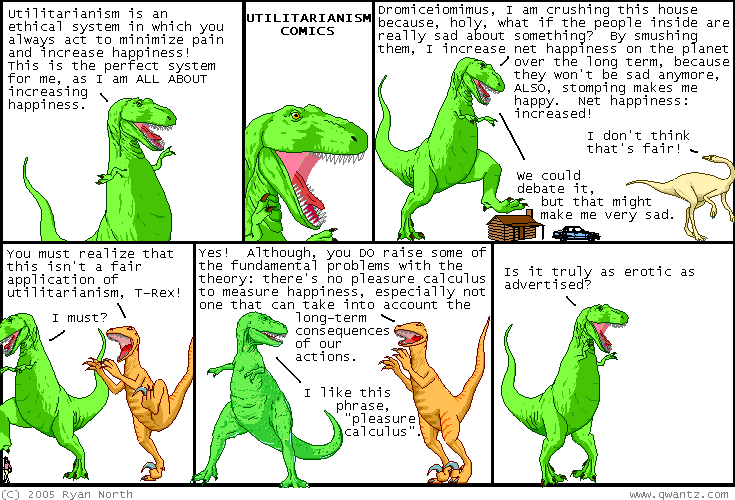
Here are some links that are loosely related to the stuff on utilitarianism that we're talking about in class.
- A neat little biography of know-it-all John Stuart Mill, one of the most famous utilitarians.
- An advanced encyclopedia article on utilitarianism and other theories that focus on consequences of an action.
- There's a lot of psychological research on happiness popping up lately. Here's one overview of positive psychology. And here's a second one.
- An insightful, accessible book on the psychology of happiness called Stumbling on Happiness.
- Recent studies suggest that our baseline level of happiness doesn't change much throughout our life. So, even if we won the lottery, we wouldn't wind up that much happier. This is potentially very depressing news, although some say there's room for some optimism, and others think the research is wrong.
- The trolley problem gets brought up a lot when evaluating utilitarianism. There's some new research on the psychology of the trolley problem.

Monday, October 19, 2009
Field Trip
UPDATE: New time! The movie starts at 3:20, not 3:30!
We're going on a class trip! On Monday, October 26th, we'll be seeing the3:30 3:20 p.m. screening of Capitalism: A Love Story at the Regal Cross Keys Cinema 12 off the Black Horse Pike in Turnersville.
You do not have to attend the trip with the class. We will, however, be discussing the movie during class on Wednesday, October 28th, so I recommend trying to see it on your own if you can't make it with us.
An interactive map of the theater's location is below. Let me know if you need a ride there.
View Larger Map
We're going on a class trip! On Monday, October 26th, we'll be seeing the
You do not have to attend the trip with the class. We will, however, be discussing the movie during class on Wednesday, October 28th, so I recommend trying to see it on your own if you can't make it with us.
An interactive map of the theater's location is below. Let me know if you need a ride there.
View Larger Map
Sunday, October 18, 2009
Incorporate Responsibly
Here are some links related to our class discussions on corporate responsibility:
- A concise biography of Milton Friedman, from a free online economics encyclopedia. (How many free online encyclopedias do you think I know about?)
- Friedman played a big role in making libertarianism and laissez-faire economic policies seem cool again...
- ... although the current financial collapse might be killing libertarianism.
- How did the subprime mortage crisis happen? The radio show This American Life gives a great explanation, and radio host Terry Gross asks Michael Greenberger to explain it.
- Why did the mortgage crisis lead to the collapse of huge financial companies? This American Life gives another great explanation. OK, Greenberger does, too.
- There's also this short play on the role that credit default swaps and netting (or hedging) played in the collapse of those huge financial companies.
Wednesday, October 7, 2009
Consensus Groups
Here are the groups for our consensus sessions, along with the article you're assigned to present on and the date you're presenting:

Enron
-Group 1 on 11/09 (Coffee article - pages 256-263): Harrison P., Matt M., Nathaniel, Suzanne
-Group 2 on 11/11 (Duska article - pages 269-278): Chris B., Kentaro, Luke, Ryan
Wal-Mart
-Group 3 on 11/16 (Jason Furman side of the article - available here): Andrew, Christina, Laura, Samantha
-Group 4 on 11/18 (Barbara Ehrenreich side of the article - available here): Chris Donahue, Dave, Joe, Shawn
Marketing & Advertising
-Group 5 on 11/23 (Carson article - pages 337-348): Fred, Harrison H., Minjin, Renee
-Group 6 on 11/25 (Arrington article - pages 348-356): Chris DeCesero, Derek, Lauren, Rob
CEO Compensation
-Group 7 on 11/30 (Fisman handout - available here): Amanda, Bryan, James
The Current Financial Crisis
-Group 8 on 12/09 (Jeffrey Friedman article- available here): Aaron, Amber, Eddie, Kerri
-Group 9 on 12/07 (Robert Pollin article - available here): Gabe, Jim, Krzysztof, Matt K.
Monday, October 5, 2009
Capitalism Extra Credit
Here's an optional extra credit assignment:
Go watch the new Michael Moore documentary Capitalism: A Love Story and write a short (about one page) response to it. What did you think of the movie? Did you like any of Moore's arguments? Did you dislike any of them? Why or why not? Try to relate the movie to what we've discussed in class.
Sunday, October 4, 2009
Unfettered Oppression Is More Like It
Here are some links related to our discussion of Karl Marx, his critique of capitalism, and communism.

- An advanced overview of the writings of Karl Marx, from one of those free online encyclopedias I keep talking about.
- Marx's complete writings are available for free online.
- What's the difference between communism and socialism?
- And for that matter, how about Marxism?
- University of Chicago's economics department is famous for supporting free market policies. Here's a critical profile of the department, along with the kind of plea for humility that I like.
- Did last year's financial collapse show that unregulated capitalism is crazy stupid?
- So does that mean we're all socialists now?
- Well, why not socialism?
Wednesday, September 30, 2009
48,000 Pins!
Here are some links related to our discussion of Adam Smith and capitalism.
- An advanced overview of the writings of Adam Smith, from my second favorite free online philosophy encyclopedia.
- (My favorite free online philosophy encyclopedia? I thought you'd never ask.)
- (Speaking of, here's their entry on philosophy of economics.)
- (Not to be outdone, economists have their own free online encyclopedia.)
- Two 20th-century economists have become popular for advocating an unfettered market: Milton Friedman (we're reading some of his stuff this semester) and F. A. Hayek. Here's Hayek's classic argument for decentralization.
- George Will gives an explanation of the invisible hand's emergent control of a free market.
- Wait, what's emergence?
- Does Adam Smith still matter? Apparently.
- What did famous philosopher Karl Popper think about the free market? You could listen to this, or check out this comic.
- As we discussed in class, America's economy isn't exactly capitalist. So what should we call it?
Wednesday, September 23, 2009
Relative to You, But Not to Me
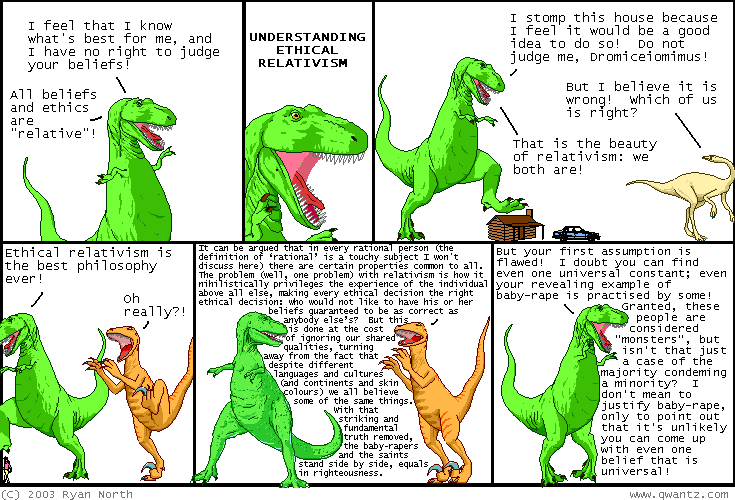
Here are some links on our first topic: are moral claims merely opinions or are they factually based?
- T-Rex says, "Beware of the relativist fallacy!"
- Cannibalism!
- INTERMEDIATE: a clarification of what moral relativism is and is not.
- ADVANCED: a detailed overview of various versions of moral relativism from my favorite free online philosophy encyclopedia.
- (Yes, there is more than one free online philosophy encyclopedia.)
- A cool interview with moral psychologist Jonathan Haidt who supports a version of moral relativism.
- A criticism of Haidt's defense of relativism.
- An argument against the DIVERSITY THESIS: in one sense, cultures morally agree more than they disagree.
- Who's to say what's right or wrong? How about philosophers?

Monday, September 21, 2009
Lonely Quiz
The first quiz will be held at the beginning of class on Monday, September 28th. You will have about 25 minutes to take it. The quiz is worth 10% of your overall grade.
There will be two sections: the first section is on evaluating arguments, and will look just like the group work on evaluating arguments from last week. There will also be a section of 4 or 5 short answer questions on the topic of moral relativism and realism (Are moral claims merely opinions or are they factually based?) These questions will be based on our class discussions of the handout and pages 1-6 of the textbook.

There will be two sections: the first section is on evaluating arguments, and will look just like the group work on evaluating arguments from last week. There will also be a section of 4 or 5 short answer questions on the topic of moral relativism and realism (Are moral claims merely opinions or are they factually based?) These questions will be based on our class discussions of the handout and pages 1-6 of the textbook.
Sunday, September 20, 2009
Evaluating Args
Here are the answers to the handout on evaluating arguments that was offered as extra credit. Perhaps I should have titled the handout "So Many Bad Args!"
1) All humpback whales are whales.
All whales are mammals.
All humpback whales are mammals.
1) All humpback whales are whales.
All whales are mammals.
All humpback whales are mammals.
P1- true
P2- true
structure- good
overall - good
2) (from Stephen Colbert)
Bush was either a great prez or the greatest prez.
Bush wasn’t the greatest prez.
Bush was a great prez.
Sean has a cat.
Sean's cat can speak German.
Some knock-knock jokes are funny.
Some annoying things are funny.
All whales live in the ocean.
All mammals live in the ocean.
All bearded people are mean.
Some dads are mean.
All boring things are taught by Sean
This class is taught by Sean.
All humans are mammals.
All students in this room are humans.
 9) All hornets are wasps.
All wasps are insects.
All insects are scary.
All hornets are scary.
All men are mammals.
All men are women.
Sean is singing right now.
Students are cringing right now.
Sean isn't singing right now.
Students aren't cringing right now.
Students aren't cringing right now.
Sean isn't singing right now.
Students are cringing right now.
Sean is singing right now.

Bush was either a great prez or the greatest prez.
Bush wasn’t the greatest prez.
Bush was a great prez.
P1- questionable ("great" is subjective)3) Some cats can speak German.
P2- questionable ("great" is subjective)
structure- good (it's either A or B; it's not A; so it's B)
overall- bad (bad premises)
Sean has a cat.
Sean's cat can speak German.
P1- false4) All knock-knock jokes are annoying.
P2- true! (I have two; there they are! ------------>)
structure- bad (the 1st premise only says some can speak German; Sean's cat could be one of the ones that doesn't)
overall- bad (bad structure)
Some knock-knock jokes are funny.
Some annoying things are funny.
P1- questionable ("annoying" is subjective)5) All whales are mammals.
P2- questionable ("funny" is subjective)
structure- good (the premises establish that some knock-knock jokes are both annoying and funny; so some annoying things [those jokes] are funny)
overall - bad (bad premises)
All whales live in the ocean.
All mammals live in the ocean.
P1- true6) Some dads have beards.
P2- true (if interpreted to mean "Whales are the sorts of creatures whose natural habitat is the ocean.") or false (if interpreted to mean "Each and every living whale lives in the ocean," since some whales, like Shamu, live in SeaWorld or other zoos)
structure- bad (we don't know much about the relationship between mammals and creatures that living in the ocean just from the fact that whales belong to each of those groups)
overall- bad (bad structure)
All bearded people are mean.
Some dads are mean.
P1- true7) This class is boring.
P2- questionable ("mean" is subjective)
structure- good (if all the people with beards were mean, then the dads with beards would be mean, so some dads would be mean)
overall- bad (bad 2nd premise)
All boring things are taught by Sean
This class is taught by Sean.
P1-questionable ("boring" is subjective)8) All students in this room are mammals.
P2- false (nearly everyone would agree that there are some boring things not associated with your teacher Sean)
structure- good
overall- bad (bad premises)
All humans are mammals.
All students in this room are humans.
P1- true
P2- true
structure- bad (it's the same structure as argument #10 below; the premises only tell us that students and humans both belong to the mammals group; we don't know enough about the relationship between students and humans from this; for instance, what if a dog were a student in our class?)
overall- bad (bad structure)
9) All hornets are wasps.All wasps are insects.
All insects are scary.
All hornets are scary.
P1- true!10) All women are mammals.
P2- true
P3- questionable ("scary" is subjective)
structure- good (same structure as in argument #1, just with an extra premise)
overall- bad (bad 3rd premise)
All men are mammals.
All men are women.
P1- true11) If Sean sings, then students cringe.
P2- true
structure- bad (just because men and women belong to the same group doesn't mean that men are women; same bad structure as in arg #8)
overall- bad (bad structure)
Sean is singing right now.
Students are cringing right now.
P1- questionable (since you haven't heard me sing, you don't know whether it's true or false)12) If Sean sings, then students cringe.
P2- false (I'm not singing now!)
structure- good
overall- bad (bad premises)
Sean isn't singing right now.
Students aren't cringing right now.
P1- questionable (again, you don't know)13) If Sean sings, then students cringe.
P2- true
structure- bad (from premise 1, we only know what happens when Sean is singing, not when he isn't singing; students could cringe for a different reason)
overall- bad (bad 1st premise and structure)
Students aren't cringing right now.
Sean isn't singing right now.
P1- questionable (again, you don't know)14) If Sean sings, then students cringe.
P2- true
structure- good
overall- bad (bad 1st premise)
Students are cringing right now.
Sean is singing right now.
P1- questionable (again, you don't know)
P2- false
structure- bad (from premise 1, we only know that Sean singing is one way to guarantee that students cringe; just because they're cringing doesn't mean Sean's the one who caused it; again, students could cringe for a different reason)
overall- bad (bad premises and structure)
Friday, September 11, 2009
Wednesday, September 9, 2009
Club Meeting
 So, I run a club called "Owning Our Ignorance" that's devoted to fun and reasoning, but more funning than reasoning. Shut up, "funning" is too a word.
We're having our first meeting of the school year Sunday night at the Barnes & Noble in Deptford. More info on the meeting and the club are available here.
If you're interested, come on out!
Wednesday, September 2, 2009
Email Subscription
A blog (short for “web log”) is a website that works like a journal – users write posts that are sorted by date based on when they were written. You can find important course information (like assignments, due dates, reading schedules, etc.) on the blog. I’ll also be updating the blog throughout the semester, posting interesting items related to the stuff we’re currently discussing in class. You don't have to visit the blog if you don't want to. It's just a helpful resource. I've used a blog for this course a lot, and it's seemed helpful. Hopefully it can benefit our course, too.
Since I’ll be updating the blog a lot throughout the semester, you should check it frequently. There are, however, some convenient ways to do this without simply going to the blog each day. The best way to do this is by getting an email subscription, so any new blog post I write automatically gets emailed to you. (You can also subscribe to the rss feed, if you know what that means.) To get an email subscription:
1. Go to http://rowanbizethics09.blogspot.com.
2. At the main page, enter your email address at the top of the right column (under “EMAIL SUBSCRIPTION: Enter your Email”) and click the "Subscribe me!" button.
3. This will take you to a new page. Follow the directions under #2, where it says “To help stop spam, please type the text here that you see in the image below. Visually impaired or blind users should contact support by email.” Once you type the text, click the "Subscribe me!" button again.
4. You'll then get an email regarding the blog subscription. (Check your spam folder if you haven’t received an email after a day.) You have to confirm your registration. Do so by clicking on the "Click here to activate your account" link in the email you receive.
5. This will bring you to a page that says "Your subscription is confirmed!" Now you're subscribed.
If you are unsure whether you've subscribed, ask me (609-980-8367; landis@rowan.edu). I can check who's subscribed and who hasn't.

Monday, August 31, 2009
Course Details
Rowan University, Fall 2009
Philosophy 09322, Section 01
Tuesdays and Thursdays, 4:45 p.m. – 6:00 p.m.
Robinson Hall, Room 101-B
Philosophy 09322, Section 01
Tuesdays and Thursdays, 4:45 p.m. – 6:00 p.m.
Robinson Hall, Room 101-B
Instructor: Sean Landis
Email: landis@rowan.edu
Phone: 609-980-8367
Course Website: http://rowanbizethics09.blogspot.com
Required Text
Contemporary Issues in Business Ethics, 5th edition, edited by Joseph DesJardins & John McCall
(buy used from Amazon or from Half.com)
About the Course
This course is designed to introduce students to thinking critically about the ethics of economics and modern business practices. Throughout the semester, we are going to explore a handful of issues in business ethics, such as: Is capitalism an ethical economic system? Should corporations be socially responsible? Should governments regulate business practices?
In examining these topics, it is my hope that we can also develop the skills of doing philosophy—understanding and evaluating others’ attempts to answer puzzling moral questions. Ultimately, though, our main goal is to learn decision-making tools we can use to provide our own answers to these ethical dilemmas. Hopefully, we will discover that careful, systematic, and critical thought about moral issues can be fruitful.

Grades
A = 934-1000 total points
A- = 900-933 total points
B+ = 867-899 total points
B = 834-866 total points
B- = 800-833 total points
C+ = 767-799 total points
C = 734-766 total points
C- = 700-733 total points
D+ = 667-699 total points
D = 634-666 total points
D- = 600-633 total points
F = below 600 total points
Quiz 100 points
Midterm 200 points
Final 350 points
Consensus Leading 150 points
Paper 150 points
Attendance/Participation 50 points
Quiz: There will be one quiz, taken during the 4th week of class. The quiz will last 20 to 25 minutes, and be held at the beginning of the period on the scheduled day.
Exams: There will be a midterm and a final exam. The midterm tests everything covered during the first half of the course, and will last the full period (75 minutes) on the scheduled day. The final exam is cumulative—that is, it tests everything covered throughout the whole course. The final will also last 75 minutes, and will take place on the last day of class.
Consensus Leading: In the second half of the semester, we will be holding consensus sessions for each issue we discuss. These are discussion and voting sessions designed to determine whether we agree or disagree with the main points of the reading assignment for that issue. Groups of about 4 students will lead one consensus session by first giving a brief (5-10 minute) presentation and evaluation of the main arguments of the reading, and then running the consensus vote process itself.
Paper: There will be one paper (about 600-1000 words long) due toward the end of the semester. The assignment will be announced shortly after the midterm exam.
Attendance/Participation: Most of this will be based on your attendance. If you’re there every class, you’ll get full credit for your attendance grade. Also, there will be a lot of informal group work throughout the semester. Group work can impact your attendance grade.
Extra Credit: I like giving extra credit! I’ll be giving some official extra credit assignments throughout the semester. I’ll also be offering some extra credit points more informally during class time. Remind me about this if I slack off on dishing out extra credit points.
Classroom Policies
Academic Integrity: Cheating and plagiarism (using someone else’s words or ideas in a paper or assignment without giving credit to the source) will not be tolerated in the class. Students found guilty of either will definitely fail the exam or assignment—and possibly the entire class. FYI: I’m pretty good at catching plagiarists. I recommend not trying it!
Excused Absenses: Make-up exams, quizzes, in-class projects, and oral reports will only be rescheduled for any excused absences (excused absences include religious observance, official college business, and illness or injury – with a doctor’s note). An unexcused absence on the day of any assignment or test will result in a zero on that assignment or test.

Course Schedule
September 2: Intro to Class
Wednesday Introduction to Class (no reading)
September 7—9: Doing Philosophy
Monday LABOR DAY (no class)
Wednesday Doing Philosophy | James Rachels (handout)
September 14—16: Ethics
Monday Doing Philosophy: Understanding & Evaluating Arguments | (no new reading)
Wednesday Are moral claims facts or opinions? | (pages 1-6)
September 21—23: Ethics/Quiz
Monday Are moral claims facts or opinions? | (no new reading)
Wednesday QUIZ #1; Sample Consensus Session
September 28—30: Capitalism vs. Communism
Monday Capitalism | Adam Smith (handout)
Wednesday Communism | Karl Marx (handout)
October 5—7: Free Market
Monday Free Market | Milton Friedman (pages 6-22)
Wednesday Free Market | The Utilitarian Argument (pages 32-43)
October 12—14: Free Market / Corporate Responsibility
Monday Free Market | The Rights Arguments (pages 55-63)
Wednesday Corporate Responsibility | (pages 64-76)
October 19—21: Corporate Responsibility
Monday Corporate Responsibility | Lynn Stout (pages 84-96)
Wednesday Corporate Responsibility | Friedman, Mackey, & Rodgers (Reason handout)
October 26—28: Midterm
Monday catch up & review for Midterm | (no new reading)
Wednesday MIDTERM
November 2—4: “The Corporation”
Monday “The Corporation” (in-class viewing of the movie) (no new reading)
Wednesday “The Corporation” continued; class discussion (no new reading)
November 9—11: Enron
Monday Enron: Regulation | John Coffee (pages 256-263); Consensus Session #1
Wednesday Enron: Auditing Ethics | Ronald & Brenda Duska (pages 269-278); Consensus Session #2
November 16—18: Wal-mart
Monday Wal-mart | Jason Furman (Slate handout); Consensus Session #3
Wednesday Wal-mart | Barbara Ehrenreich (Slate handout); Consensus Session #4
November 23—25: Advertising Ethics
Monday Advertising Ethics | Thomas Carson (pages 337-348); Consensus Session #5
Wednesday Advertising Ethics | Robert Arrington (pages 348-356); Consensus Session #6
November 26—29: THANKSGIVING BREAK (no class) (woo?)
November 30—December 2: CEO Compensation / Current Financial Crisis
Monday CEO Compensation | Ray Fisman (Slate handout); Consensus Session #7
Wednesday Current Financial Crisis | (handout); Consensus Session #8
December 7—9: Current Financial Crisis / Review
Monday Current Financial Crisis | (handout); Consensus Session #9
Wednesday PAPER due; review for Final Exam
December 14: Final Exam
Monday FINAL EXAM

Wednesday Introduction to Class (no reading)
September 7—9: Doing Philosophy
Monday LABOR DAY (no class)
Wednesday Doing Philosophy | James Rachels (handout)
September 14—16: Ethics
Monday Doing Philosophy: Understanding & Evaluating Arguments | (no new reading)
Wednesday Are moral claims facts or opinions? | (pages 1-6)
September 21—23: Ethics/Quiz
Monday Are moral claims facts or opinions? | (no new reading)
Wednesday QUIZ #1; Sample Consensus Session
September 28—30: Capitalism vs. Communism
Monday Capitalism | Adam Smith (handout)
Wednesday Communism | Karl Marx (handout)
October 5—7: Free Market
Monday Free Market | Milton Friedman (pages 6-22)
Wednesday Free Market | The Utilitarian Argument (pages 32-43)
October 12—14: Free Market / Corporate Responsibility
Monday Free Market | The Rights Arguments (pages 55-63)
Wednesday Corporate Responsibility | (pages 64-76)
October 19—21: Corporate Responsibility
Monday Corporate Responsibility | Lynn Stout (pages 84-96)
Wednesday Corporate Responsibility | Friedman, Mackey, & Rodgers (Reason handout)
October 26—28: Midterm
Monday catch up & review for Midterm | (no new reading)
Wednesday MIDTERM
November 2—4: “The Corporation”
Monday “The Corporation” (in-class viewing of the movie) (no new reading)
Wednesday “The Corporation” continued; class discussion (no new reading)
November 9—11: Enron
Monday Enron: Regulation | John Coffee (pages 256-263); Consensus Session #1
Wednesday Enron: Auditing Ethics | Ronald & Brenda Duska (pages 269-278); Consensus Session #2
November 16—18: Wal-mart
Monday Wal-mart | Jason Furman (Slate handout); Consensus Session #3
Wednesday Wal-mart | Barbara Ehrenreich (Slate handout); Consensus Session #4
November 23—25: Advertising Ethics
Monday Advertising Ethics | Thomas Carson (pages 337-348); Consensus Session #5
Wednesday Advertising Ethics | Robert Arrington (pages 348-356); Consensus Session #6
November 26—29: THANKSGIVING BREAK (no class) (woo?)
November 30—December 2: CEO Compensation / Current Financial Crisis
Monday CEO Compensation | Ray Fisman (Slate handout); Consensus Session #7
Wednesday Current Financial Crisis | (handout); Consensus Session #8
December 7—9: Current Financial Crisis / Review
Monday Current Financial Crisis | (handout); Consensus Session #9
Wednesday PAPER due; review for Final Exam
December 14: Final Exam
Monday FINAL EXAM
Subscribe to:
Posts (Atom)